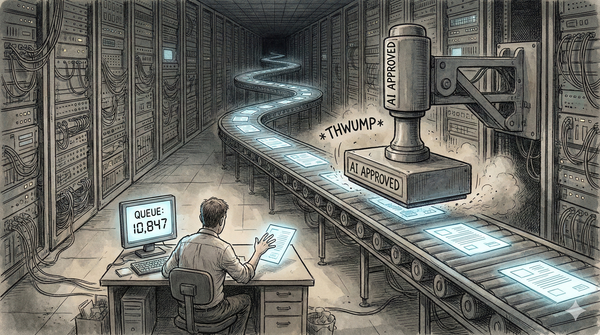
OpenAI wants a speed limit. It brought its own radar gun.
The proposal names no shared test, no number, no keeper and no appeal. The only measurements on the table are OpenAI's own, and my own bench records show what turns up when a measurement gets opened.


On November 22, OpenAI's chief scientist, Jakub Pachocki, asked the AI industry to agree on a line no lab crosses until the safety science catches up, measured by a number every lab can track. [1]
Read it twice and count what is missing. There is no number for the limit. There is no shared test. Nobody is named to keep the test, nobody to check a score, and there is nowhere to appeal one. What the essay does contain is a chart of OpenAI's models, scored by OpenAI, on a test cut from OpenAI's own source code.
That is a speed limit with no posted speed and no traffic court, and the only radar gun anyone has seen is bolted to one of the cars.
Every number in the essay comes from OpenAI's code
The metric is perplexity: how well a model guesses the next scrap of text. Lower is better. Every figure in the essay is the log of that metric, taken on a held-back slice of OpenAI's internal codebase. GPT-3.5 scored about 0.99. GPT-4 scored about 0.91. The recent models are under 0.8, and the essay credits one at about 0.76 with a run of results on open problems in mathematics. Pachocki describes the answers piling up in one Slack thread and says it felt surreal. I believe him.
Below the newest named model the chart has one more dot, labelled only as an internal model. Below that is a shaded band starting at 0.70 with a question mark in it. Pachocki writes that he does not know what a model in that band will be able to do.
So the lab asking where everyone should stop is, on its own chart, a short step from the territory it says nobody understands. The essay does not say whether the line it wants would fall in front of that dot or behind it.
I'll take the alarm at face value. No conspiracy is required for anything that follows. Sincerity does not calibrate an instrument.
The chart has numbers. The rule has none.
The models get figures. The limit gets the subjunctive.
The hardest question in the whole proposal is how you compare one lab's number with another's when every lab trains on different data and tests on different data. The essay raises it and answers with a hope: "if we establish a goal of transparency we can find transferable ways to compare." [1]
That clause is the entire plan for comparing one lab with another.
The essay knows exactly why the question matters. One of its own footnotes concedes that scoring OpenAI's early models on code says little about what they could do, because of what they were trained on, and flags that as a challenge for using the number as a shared metric. Its own list of weaknesses says the number maps directly onto no task anyone cares about, and that the reasoning techniques behind a drastic jump in what models can do leave it unmoved.
Put that together in the author's own terms. The reading changes with what a model was fed. It tracks no task you could point to. It cannot see a kind of improvement the essay itself calls drastic. This is the metric the essay puts first as the basis for telling a lab to stop.
This is the house style of the whole field, and I work in it. The field will spend a year shaving a hundredth off a loss curve and treat "who gets to check" as somebody else's ticket. The essay is that habit at industrial scale. The curve is drawn in detail. The rule is left as an exercise for the reader.
Blanks do not stay blank
If a limit exists, somebody takes the reading. Somebody decides which dataset counts, and which version. Somebody rules when a lab says the test is broken. Somebody declares the safety milestone met and lets the limit lift. The essay names none of them.
Naming them would not be enough. An honest referee can administer a meaningless number perfectly. Somebody also has to show what the line detects: that the number means the same thing for a lab that is not OpenAI, and which capabilities can grow without moving it. The essay lists both as open problems and proposes the limit anyway.
Blanks in a standard get filled by whoever shows up with numbers, and one lab just showed up with numbers. The essay presents its chart as a cost it chose to bear, since competitors can now see where OpenAI stands. Whatever the intent, the chart also works as an opening bid. The first chart on the table tends to become the table.
Notice the trap in the frame, too. Start arguing over whether the line belongs at 0.70 or 0.72 and you have skipped the only questions that matter: 0.70 of what, measured by whom, checked by whom.
A number nobody outside can check is not a standard. It is a press release.
What my own measurements did when they were opened
I build measurement software and run it on machines I own, with AI assistants doing much of the labor, OpenAI's included. On August 1 I told one of them to build me a lab that would get me "an answer that is definitive", one I could run "on MY hardware". My records from this year hold three failures that came to light only because the files could be reopened. [2][3][4]
The tell that flipped. In August my measurement kit had a signal that looked good. When a model did almost no reasoning before it answered, it was more likely to be wrong. On the tasks where the signal qualified, that held. On a differently built mix of tasks the relationship reversed. Same signal, opposite meaning. The release gives it no authority at all: it cannot trigger a retry, an escalation or an approval. The rule that came out of it says a signal has to point the same way on at least two structurally different sets of work before the controller lets it decide anything. [2]
That rule governs one small controller and it is not a test of perplexity. The lesson underneath it is the one the essay skips. A measurement earns authority in the setting where it was checked. Anywhere else, it has to earn it again. Every figure OpenAI has shown is one lab's models on one lab's data. A limit across labs needs evidence taken across labs.
Thirty-nine percent, and a recount of seventy. In October a small local model ran 162 raw-code attempts on my bench. It passed 63. The score is 39 percent and it stays 39 percent. In November a recount went back through the 97 answers that had come back and failed. Fifty of them had working code inside the reply: pull the function out and it matched the reference output on every stored test input. That makes 113 of 162, or 70 percent, as a diagnosis of how the answers were being read. [3][4]
| Quantity | Count | Meaning |
|---|---|---|
| Original native result | 63/162, or 38.9% | Outcome of the original campaign, including transport failures |
| Original passes plus extracted canonical matches | 113/162, or 69.8% | Diagnostic count retaining the complete attempt denominator |
| Same diagnostic count among returned responses | 113/160, or 70.6% | Diagnostic count after excluding the two transport errors |
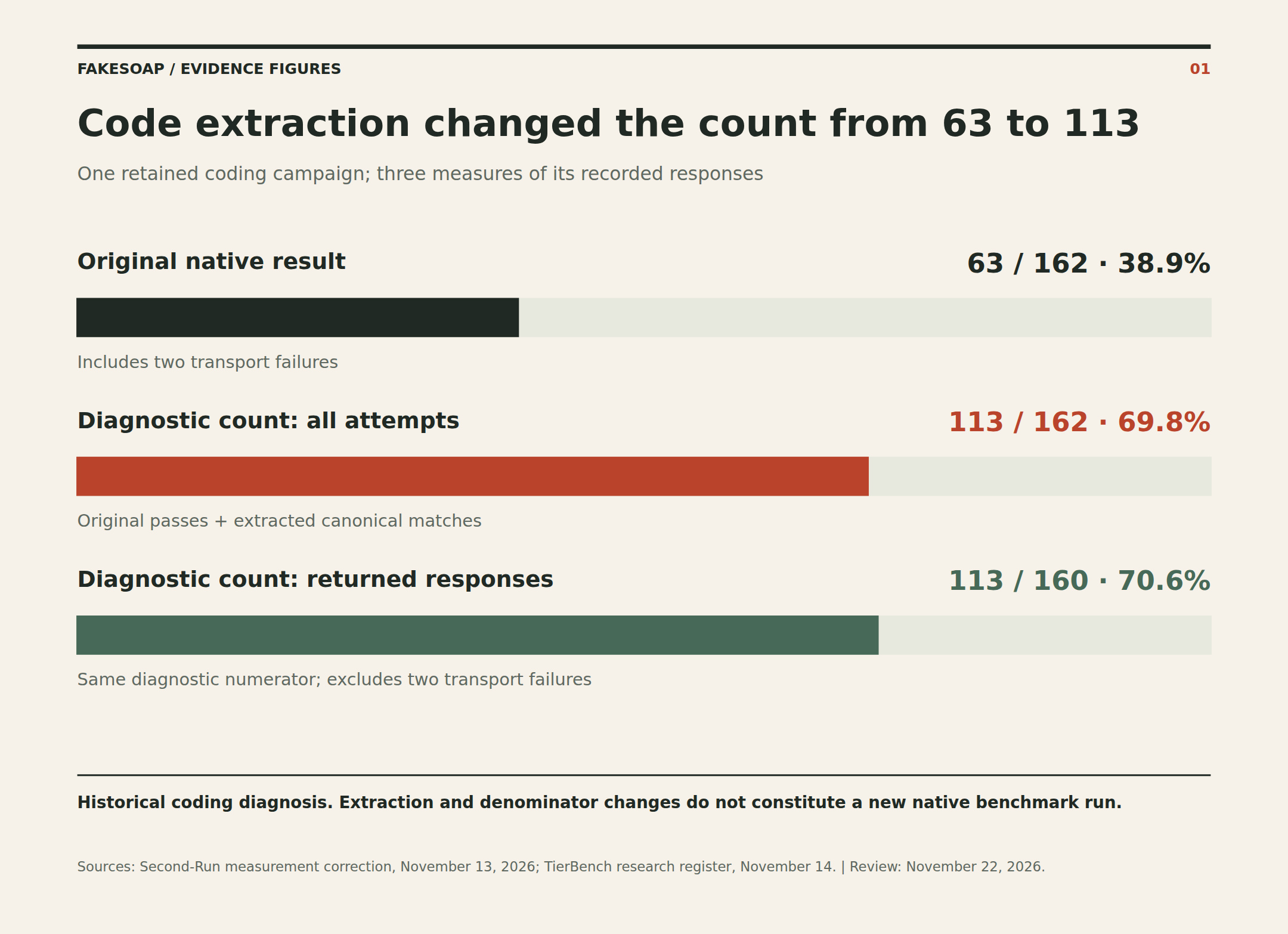
The model produced no new answers between those two numbers. My package keeps them apart and labelled: one is the test as given, the other is a recount. Nothing outside my own rules forced that. A test owner who wanted the better headline could have published 70, and nobody without the files could have said otherwise.
The answer key that flunked. In the same investigation, the grader failed the benchmark's own reference solution on one task. A failure there tells you about the test, not the model. The corrected package excludes that task from every conclusion about the model until the defect is fixed. [3][4]
Each of those corrections was possible because the recorded answers, the reference outputs and the grader were all on hand to be reopened. Take away that access and the 39, the 70 and the broken task are whatever the owner says they are.
Fill in the blanks, then ask
Before any lab signs anything:
- Show what the line detects. Evidence that the number means the same thing across labs, and a plain list of the capabilities that can grow without moving it.
- Name the keeper. The test lives with a custodian that does not train frontier models.
- Publish the spec. Dataset version, task mix, scoring procedure, decision rule. A later score has to be able to tell a stronger model from a changed test.
- Score every lab that would be bound, the same way, by the same hands, before the limit binds anyone.
- Write the appeal. Who can challenge a reading, who rules, who can overturn it, and how a lab stopped by a bad test gets started again.
- Say the number, and say who decides it can lift.
- Break it on purpose. Run the correction process once, in public, on a real defect, before the measure is allowed to limit anyone. The correction to my own results is dated the month after the run, on a test far simpler than this one.
OpenAI published its numbers and called it a first step. Fine. It is one. The second step is a test kept by someone who is not in the race.
Until then this is not a speed limit. It is one driver asking the rest of the road to trust his speedometer.
Reporting and method
I build measurement and agent software, including TierBench, Cantos and Second-Run, and I use OpenAI and Anthropic products to do it. AI assistants working under my direction produced much of the record cited here. Sources 2 to 4 are my own files and are not public, so you are taking my word for them. That is the position this article says nobody should be put in by a rule with force behind it.
The examples are small: one signal in one controller, and 162 raw-code attempts by a local Qwen3.5 9B model, two of which were transport errors that stay counted as failures. They did not measure perplexity, did not touch OpenAI's dataset, and say nothing about where a limit belongs. OpenAI's essay does not say that its internal dataset would become the common test, or that OpenAI would keep or score it. It says nothing on those points, and that silence is the complaint. The seven steps are my recommendations. I ran no new model evaluations for this piece.
Sources
- Jakub Pachocki, Chief Scientist at OpenAI, November 22, 2026. Perplexity and Intelligence. The proposal, the chart, the list of challenges and footnotes 3 and 4.
- Author's retained release record, August 3, 2026. TierBench-Magic-Lasso-v1.1.0-ACCEPTANCE.md. Admission rule and controller scope.
- Author's retained research register, November 14, 2026. tierbench_research_evidence_20261114.md, sections E3, E5 and E7.
- Author's retained Second-Run measurement package, corrected November 13, 2026. Reproducible measurement correction, README. Original campaign count, extraction recount and the reference-solution grader failure.