THE GODS WHO WON’T GO OUTSIDE


The contest is not simply between an old bureaucratic elite and a new founder elite. It is between two forms of agoraphobic sovereignty, both terrified of leaving the control room and encountering a world that can return an answer they did not authorize.
The old gods and the aspirant gods differ in style. The old order protects itself through procedure, credentialing, consultation, jurisdictional fragmentation, and indefinite deferral. The new order protects itself through founder control, private capital, platform ownership, executive command, trusted cadres, and the deletion of rival veto points. One avoids responsibility by distributing it until no one can act. The other concentrates responsibility until no one else can interrupt. Both arrangements extract information from the outside while resisting the outside’s claim to alter the objective.
That is almost exactly what the Clifford lake was built to detect. In POOF, the person does not disappear from the database. The person becomes more visible while losing standing as a constituent actor capable of challenging what the representation is for. A protected center can accept enormous amounts of intelligence from collaborators, users, workers, sensors, agencies, and publics while preserving exclusive control over final purpose. The asymmetry appears when the center may act prospectively on intuition or risk, while the affected person must later prove causation, injury, intent, and the superiority of an alternative that was never allowed to operate.
NRx is a fantasy of eliminating the outside
Mencius Moldbug’s formalism and Patchwork do not really solve politics. They attempt to reclassify politics as property administration. The polity becomes a sovereign corporation, government becomes management, the ruler becomes a chief executive, and the citizen’s ultimate remedy becomes departure. Yarvin’s writings are foundational to what became NRx and explicitly develop corporate-sovereign “patchwork” jurisdictions. (Digital Collections)
That is not a fearless encounter with social disorder. It is fear of plural sovereignty rendered as a cap table. Voice is intolerable because another person may remain inside the shared world while insisting that the objective itself is wrong. Exit is cleaner. The dissenter leaves the property, the sovereign retains authorship, and the system avoids having to treat disagreement as a legitimate source of constitutional change.
Clifford exposes the missing premise. Exit is meaningful only when a person can leave without losing practical membership in work, markets, health care, community, infrastructure, or polity. Once the corporate jurisdiction supplies indispensable infrastructure, “vote with your feet” becomes fictional. The founder obtained freedom from the public, then scaled the private system until the public could no longer obtain freedom from the founder.
This is the contradiction connecting NRx to Thiel. In 2009, Thiel wrote that he no longer believed freedom and democracy were compatible and described technology as a means of creating new spaces for escape from existing political constraint. PayPal’s founding vision, in his own account, involved a currency outside government monetary control; cyberspace, seasteading, and space were presented as possible jurisdictions of exit. (Cato Unbound) Clifford then supplies the second half of the story: interests become infrastructure, infrastructure becomes necessity, and necessity becomes power. The enclave built to escape collective veto eventually becomes a platform, supplier, data environment, communications layer, or market-maker through which collective life must operate.
The builder exits politics and returns as infrastructure.
The PayPal Mafia is an estate, not a secret committee
The PayPal Mafia matters because it is a pre-power compact capable of carrying habitus, capital, personnel, trust, and institutional technique across domains. Former PayPal founders and employees remained linked as business and social associates and went on to establish or finance companies across software, platforms, aerospace, finance, data, and venture capital. (Wikipedia) That does not prove coordinated political design, and Clifford properly forbids that shortcut.
The stronger account does not need a conspiracy. The Clifford thesis explicitly distinguishes structural convergence, opportunistic exploitation, deliberate market shaping, institutional replacement, ideological governance, and personal extraction. Recurrence alone does not establish intent. What matters is which bounded surfaces existed, which roles overlapped, which instruments converted ideas into authority, and which actors retained control or residual value.
POOF gives the precise mechanism: pre-power trust can become an informal constitution after scale. Trusted operators can argue honestly inside a compact because loyalty to the project is settled in advance. That arrangement can produce speed, coherence, and unusually candid internal dissent. Outsiders, however, cannot invoke the friendship as a right. Their protection depends on whether a trusted operator hears them, translates them accurately, retains access, and remains in favor with the center.
This is why “PayPal Mafia” should be treated as a personnel-routing and legitimacy estate, rather than a room in which everyone agrees on a master plan. It reproduces a disposition:
- small, trusted teams outperform general institutions;
- ownership protects necessary long-term judgment;
- consensus is usually late;
- regulation is an adversarial surface;
- institutional incumbents confuse procedure with competence;
- speed and survival validate the operator;
- outsiders may advise, but only trusted insiders may alter direction.
That disposition was adaptive in a specific field. Early internet companies faced fraud, hostile incumbents, capital scarcity, rapid technical change, and existential competition. The error was treating the resulting habitus as universal constitutional competence.
DOGE was the live transplant
Clifford’s seven conversions let us describe the NRx-to-DOGE lineage without claiming that Yarvin authored DOGE or that every participant shared NRx doctrine.
NRx and adjacent founder writing performed agenda formation by supplying the vocabulary: democracy as latency, bureaucracy as hostile middleware, the administrative state as an illegitimate distributed sovereign, the founder as the scarce locus of judgment.
The PayPal and venture networks performed option-set formation by financing companies, creating fellowships and alternative credentialing systems, routing personnel, supporting media and political ventures, and establishing which technical operators appeared credible before any public gate.
Trump supplied public conversion. Electoral authority, appointments, executive orders, and administrative command turned a counter-elite critique into an operative state project.
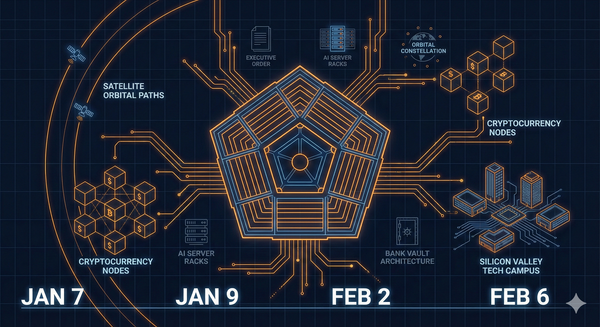
DOGE became the control architecture. The January 2025 executive order renamed the United States Digital Service as the United States DOGE Service, created a temporary DOGE organization, and required agencies to establish embedded DOGE teams. Later orders gave those teams roles in hiring, workforce reduction, contract review, grants, loans, regulation, and spending. (The White House) This was not merely a commission issuing recommendations. It was an attempt to place a founder-style operating layer across existing agencies.
That is why DOGE is so revealing. It tested whether startup habitus could be transplanted into a constitutional state by granting a small cadre access to systems, records, personnel decisions, procurement objects, and institutional workflows. The transplant encountered a world containing statutes, appropriations, due process, labor law, program missions, accumulated records, multiple authorities, external beneficiaries, and costs that did not resolve into a single metric.
The official temporary organization reached its scheduled end on July 4, 2026. A subsequent federal audit found major defects in the public “Wall of Receipts,” including unsupported or overstated savings, lease terminations already underway, and a claimed $1.7 billion contract cancellation that had not occurred. (The White House) That is nearly a laboratory demonstration of the POOF failure mode: an institution preserves its ability to record success while weakening its ability to preserve a meaningful miss. In the book’s formulation, the system learns without becoming falsifiable when failure can always be redescribed as incomplete implementation, hostile conditions, bad data, or institutional sabotage.
DOGE did not fail merely because government is complicated. It failed at the exact constitutional seam the founder model tries to erase. It wanted authority to reinterpret the institution before accepting that the institution’s independent records, jurisdictions, and affected populations could return binding evidence against the intervention.
Musk is the vanguard because he accepts only one kind of outside
Musk complicates the argument because he has plainly gone outside in the material sense. Rockets explode. Engines fail. Factories jam. Launch windows close. Physical systems can return brutal and unambiguous feedback. His organizations have often been unusually willing to expose artifacts to that feedback.
The distinction is between material veto and constituent veto.
The material world does not demand standing. A rocket does not possess a rival objective. Its explosion can be absorbed as telemetry while the founder retains complete authority over the mission. Engineers may change the design, but the purpose of the system remains intact.
Workers, regulators, communities, agencies, voters, customers, and foreign states are different. They do not merely report whether the founder’s mechanism works. They possess interests that may require changing what the mechanism is for, who bears its risks, what may be done, and whether the project should continue. Their resistance cannot always be converted into engineering information without stripping away the political claim embedded in it.
Musk therefore represents the vanguard less because he is uniquely fearless than because he is unusually skilled at confronting instrumentable reality while seeking to convert non-instrumentable human disagreement into noise, sabotage, latency, or bad faith. The world is welcome when it behaves like a test range. It becomes intolerable when it behaves like another sovereign.
POOF’s positive criterion is sharper. Strong authorship survives contact with real limits without converting every limit into proof of the author’s original theory. A world fights back when another actor, material, or institution possesses the practical right to be inconvenient. The test is not whether a founder listens. It is whether an inconvenient result can survive disagreement with the founder and still alter the operating state.
The old gods have the same disease in inverse form
The legacy administrative order also fears the outside. Its method is different. It does not usually claim that one founder should possess root access. It builds procedures, consultations, compliance systems, review panels, professional vocabularies, and distributed jurisdictions. These can protect people and preserve knowledge. They can also become technologies for ensuring that no unanticipated person or event can impose a terminal obligation.
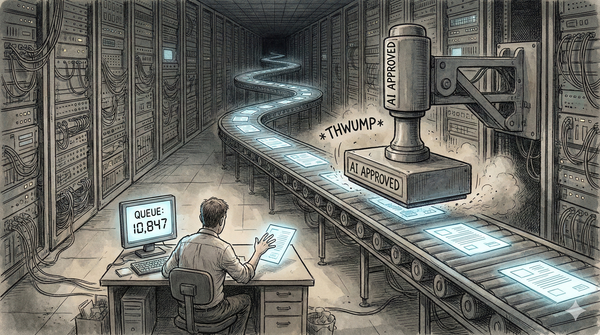
The old order often permits everyone to contribute information while no one can force a decision. Criticism becomes engagement. Harm becomes a case file. Failure becomes a recommendation. Responsibility circulates among offices until the represented person has been fully documented and no institution has acquired a duty to change the objective.
The new order sees that paralysis and correctly identifies something rotten. It then proposes an opposite cure that preserves the same constitutional defect. It gives someone the ability to decide but does not give the exposed world standing to produce an unwanted answer.
The old gods create procedural enclosure. The new gods create proprietary enclosure.
The old order says the world is too complex for decisive public judgment, so authority must remain with accredited institutions. The new order says the world is simpler than those institutions claim, so authority must remain with an exceptional principal and his trusted operators. Both arrangements make their own competence self-legitimating. Both reserve intuition for the center and proof burdens for the periphery. Both distrust a genuinely external jurisdiction.
Their war is therefore partly a struggle over who owns the indoor model.
Trump is the battering ram, but he is also trapped inside the spectacle
Trump is not simply an NRx monarch. His authority depends on mass acclamation, grievance, spectacle, repetition, and a personal claim to embody the people. NRx is more comfortable with elite administration than populist turbulence. Yet Trump performs the public conversion NRx alone could never achieve. He turns counter-elite capital, doctrine, personnel, and media infrastructure into appointments and executive authority.
He also shares the protected-center pathology. The crowd may authorize him, but it does not co-author the objective after authorization. Loyalty is treated as evidence. Opposition is treated as corruption, conspiracy, or illegitimacy. Institutions are valuable when they ratify the sovereign and hostile when they retain independent judgment.
So Trump crashes the old gates, but he does not really go outside either. He reconstructs the outside as audience. The public can cheer, punish enemies, validate dominance, and provide affective feedback. It is much harder for the public to become a constituted power capable of binding the project from within.
The deeper failure is theological
The aspirant god wants omniscience without vulnerability. He wants every signal, every record, every transaction, every person, every dependency, and every possible threat rendered into an operating picture. But he does not want another intelligence inside the picture to acquire jurisdiction over him.
The old gods already reached that condition. Their systems can model populations, convene consultations, issue audits, and record harm while remaining incapable of letting a person’s answer reorganize the objective. The new gods saw the corpse and concluded that the problem was insufficient sovereignty. They did not notice that the corpse died from too much protected purpose and too little standing.
This is why the NRx and DOGE arc is less a successful authoritarian advance than an increasingly visible crisis of control. The new sovereign can seize gates, cancel programs, replace personnel, and produce dashboards. It cannot make the world clean. It cannot make people share one objective. It cannot turn law, memory, ecology, labor, material constraint, and public consequence into mere implementation details without losing the information needed to govern.
Clifford’s most important line for this whole formation is that no secret plan is required. Each decision can be locally rational while the resulting system becomes constitutionally closed. The PayPal Mafia does not need a conspiracy. NRx does not need to issue operational orders. Trump does not need to understand the full architecture. DOGE does not need to succeed. Shared habitus, capital, personnel routes, institutional openings, and role-switching can carry the pattern forward one conversion at a time.
The repair is not the return of the old gods, and it is not the enthronement of more competent new ones. POOF calls the answer counter-sovereignty: enforceable standing proportionate to exposure, including inspection, correction, contestation, suspension, remedy, portability, and exit. It does not require every person to veto every collective act. It requires some independent actor to preserve the miss and make final authority confront it.
The final struggle is therefore not over which elite deserves to control reality. It is whether any center, old or new, can be made to accept a result it did not author.